

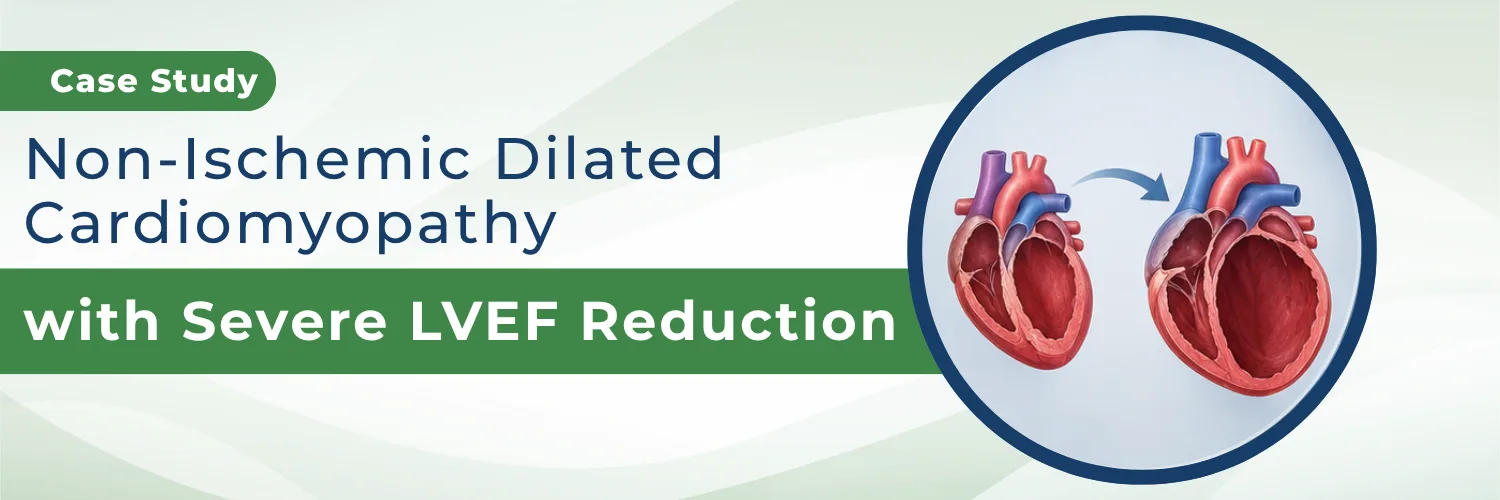
Non-Ischemic Dilated Cardiomyopathy With Severe LVEF Reduction (HFrEF)
Dr. S. A. Merchant | Advanced Heart Failure Clinic in Mumbai
Patient Profile
|
Name |
Mohd. Wasim Shaikh |
|
Age |
41 years |
|
Gender |
Male |
|
Occupation |
Employee, BPO |
|
Presenting Complaints |
Breathlessness, orthopnea, frailty, tiredness, coughing |
|
Diagnostic Workup |
2D-Echo, CPET, Cardiac MRI, CT-Coronary Angiography, NT-proBNP, 5-Day External Loop Recorder, Right Heart Catheterization |
|
Diagnosis |
Non-Ischemic Dilated Cardiomyopathy, HFrEF (LVEF 15%), Hypothyroidism, Hypotension, Ventricular Ectopy (11,866 counts) |
|
Status at Presentation |
NYHA Class III |
|
Treatment |
ICD Implantation, Guideline-Directed Medical Therapy (GDMT), listing for Heart Transplantation |
|
Outcome |
NYHA Class improved from Class III to Class II; advised Heart Transplantation |
The Problem
Condition
Mr. Shaikh, a 41-year-old male employed in a BPO, presented with breathlessness, orthopnea, frailty, tiredness, and coughing. He was evaluated at the Advanced Heart Failure Clinic by Dr. S. A. Merchant, and a structured diagnostic workup was undertaken to establish the cause of his symptoms.
The workup, comprising 2D-Echocardiography, Cardiopulmonary Exercise Testing (CPET), Cardiac MRI, CT-Coronary Angiography, NT-proBNP, a 5-day External Loop Recorder, and Right Heart Catheterization, established a diagnosis of Non-Ischemic Dilated Cardiomyopathy with Heart Failure with reduced Ejection Fraction (HFrEF), an LVEF of 15%, hypothyroidism, hypotension, and a significant burden of ventricular ectopy (11,866 counts).
Non-ischemic dilated cardiomyopathy is a condition in which the left ventricle, the heart’s main pumping chamber, becomes enlarged and weakened without any blockage in the coronary arteries being the cause. An LVEF of 15% represents a severe reduction in the heart’s pumping capacity, and at presentation Mr. Shaikh’s functional status corresponded to NYHA Class III.
Consultation and Treatment Plan
Why a Combined Approach Was Chosen?
Rather than relying on medical therapy alone, Dr. S. A. Merchant planned a combined approach addressing the immediate risk of life-threatening arrhythmia and the long-term management of severely reduced heart function together. This included ICD implantation, listing for Heart Transplantation, and a personalized heart failure treatment plan built around Guideline-Directed Medical Therapy (GDMT).
This combination reflects a standard approach in advanced and critical heart failure care, where device therapy, transplant listing, and optimized pharmacological management each address a different aspect of the patient’s condition — arrhythmia risk, disease severity, and hormonal status, respectively — while the patient continues active treatment.
Procedure Details
Overview
Mr. Shaikh’s management combined ICD implantation with Guideline-Directed Medical Therapy, alongside listing for Heart Transplantation.
Approach:
Systems addressed:
Associated finding:
Cardiologist:
ICD Implantation
An Implantable Cardioverter-Defibrillator (ICD) is a device placed under the skin, with leads positioned in the heart, that monitors heart rhythm and can deliver a corrective shock if a life-threatening arrhythmia occurs. It was advised for Mr. Shaikh in view of the severely reduced LVEF and the ventricular ectopy detected on rhythm monitoring.
Guideline-Directed Medical Therapy
Alongside device therapy, Mr. Shaikh was started on GDMT with the following add-on medications:
Vericiguat 5 mg OD — a soluble guanylate cyclase stimulator used in chronic heart failure
Amiodarone 100 mg BID — an anti-arrhythmic medication used to manage ventricular ectopy
Levothyroxine 75 mcg OD — used to manage the concurrently diagnosed hypothyroidism
Listing for Heart Transplantation
Given the severity of the ventricular dysfunction, Mr. Shaikh was listed for Heart Transplantation. This step is generally pursued alongside, rather than in place of, ongoing medical management, so that the patient continues to be actively treated while awaiting transplantation.
Post-Treatment Results
Functional status
Rhythm management
Long-term expectation
Transplant status
Patient satisfaction
Patient Feedback
Mr. Shaikh reported being satisfied with his medical therapy.
Profile: Mohd. Wasim Shaikh · Male · 41 years · Employee, BPO Management: ICD Implantation · Guideline-Directed Medical Therapy · Heart Transplant Listing Cardiologist: Dr. S. A. Merchant, Advanced Heart Failure Clinic, Bandra West, Mumbai
Frequently Asked Questions
Q1. What is non-ischemic dilated cardiomyopathy?
Q2. What does an LVEF of 15% indicate?
Q3. Why was an ICD implanted in this patient?
Q4. Why was the patient listed for heart transplantation while also on medical therapy?
Q5. What was the outcome for this patient?
Q6. Why choose Dr. S. A. Merchant?
Living With Severely Reduced Heart Function?
A consultation at the Advanced Heart Failure Clinic in Mumbai gives you the chance to understand your condition and what treatment options are realistic for you.
Disclaimer:The information on this page is for general informational purposes only and is not a substitute for professional medical advice, diagnosis or treatment. Individual results vary from patient to patient. Always consult a qualified cardiologist regarding any medical condition.